IOBRpy: From FASTQ to TME
2026-08-28
Chapter 1 Introduction
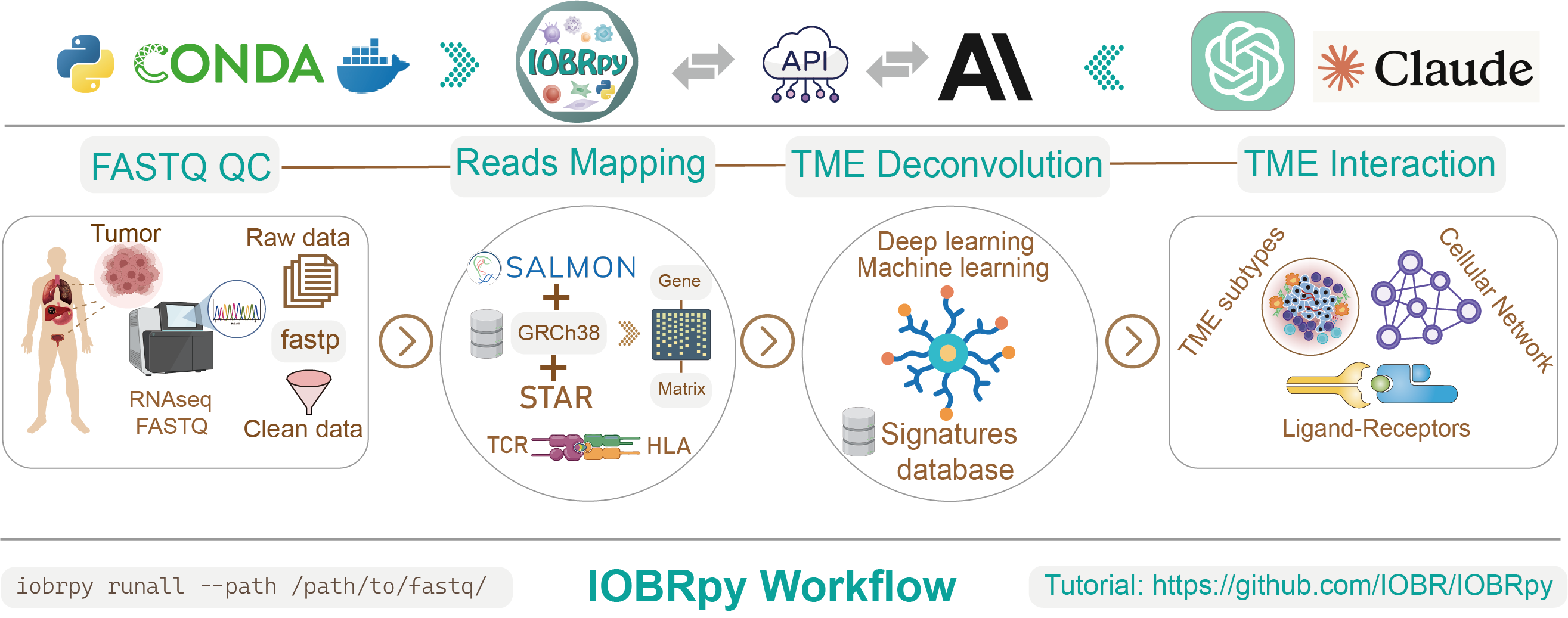
Figure 1.1: IOBRpy workflow
This tutorial presents a reproducible IOBRpy workflow that starts with public paired-end FASTQ files. It includes paired agent skills, Salmon and STAR mode runall, BayesPrism, TME clustering, NMF clustering, and HLA typing.
1.1 Output directories
All chapters use /analysis/IOBRpy_PRJNA1161405_demo as the project root. The complete workflow creates:
/analysis/IOBRpy_PRJNA1161405_demo/
├── input/
│   └── fastq/
├── reference/
│   ├── salmon/gencode44/
│   └── star/
├── results_salmon/
│   ├── 01-qc/
│   ├── 02-salmon/
│   ├── 03-tpm/
│   ├── 04-signatures/
│   ├── 05-tme/
│   ├── 06-LR_cal/
│   └── 07-TCRBCR/
├── results_star/
│   ├── 01-qc/
│   ├── 02-star/
│   ├── 03-tpm/
│   ├── 04-signatures/
│   ├── 05-tme/
│   ├── 06-LR_cal/
│   └── 07-TCRBCR/
├── bayesprism/
├── hla_typing/
├── nmf/
└── tme_cluster.csv| Directory | Contents |
|---|---|
input/fastq/ |
The ten paired-end FASTQ samples used in the worked example. |
reference/ |
GENCODE v44 reference files and the Salmon and STAR indexes. |
01-qc/ |
Cleaned FASTQ files and quality-control reports generated by fastp. |
02-salmon/ |
Salmon transcript quantification and merged count and TPM matrices. |
02-star/ |
STAR alignments, coordinate-sorted BAM files, gene-level read counts, and the merged count matrix. |
03-tpm/ |
TPM converted from the count matrix and the result after log2 transformation. |
04-signatures/ |
Sample-level scores for the included biological signatures. |
05-tme/ |
Results from the six-method TME panel and their merged profile. |
06-LR_cal/ |
Ligand-receptor activity scores calculated from the expression matrix. |
07-TCRBCR/ |
TRUST4 T-cell and B-cell receptor repertoire outputs. |
bayesprism/ |
BayesPrism immune deconvolution results. |
tme_cluster.csv |
TME clustering results. |
nmf/ |
NMF clustering results. |
hla_typing/ |
Per-sample HLA typing results and the merged HLA table. |
1.2 Example RNA-seq project
The example dataset comes from NCBI BioProject PRJNA1161405.